These two links below will take you to pdf’s containing compact pitching data. The data could be useful for tonight’s game with the Giants and Royals. This info courtesy of Richard Fabbri of Scarce Ideas, LLC.
Left-Over Book Sale Books Are Available (part 1 of 2)
Here is the first of two lists showing the left over books that were offered at the 10-25 Chapter gathering at Quinnipiac. They were offered for $1 a piece. Attendees purchased almost 30 books. These are available for a donation to the Chapter Treasury. Email me at kcicitto@cox.net if you have interest.
-Karl
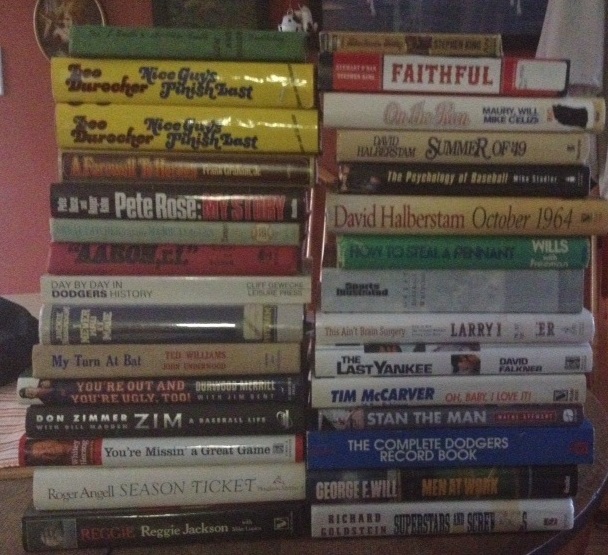
Superstars and Screwballs, 100 years Brooklyn BB.  Goldstein.  HC, W DJ.
former. Library book

Men At Work.  GF Will.  HC w DJ.  Clean.

My Turn At Bat.  Ted Williams with John Underwood.  HC w/o DJ.  Ex Libris.

Season Ticket.  R Angell.  HC w DJ.  Clean.  Small tear on DJ.

Faithful.  Stephen King & Stewart O'Nan.  Trade size SC.  Former Library book.
Clean

The Last Yankee.  Turbulent Life of Billy Martin.  HC w D j.  Small tear on. DJ.

Reggie, The Autobiography.  R Jackson with M Lupica.  HC w. DJ.  Stated First.
Small tears on DJ.

I Never Had It Made.  Jackie Robinson as told to A Duckett.  HC w DJ.  Former
Library book.

Low and Inside.  Ira and H. Allen Smith.  HC, no DJ.  Ex Libris.

Blockade Billy.  Stephen King.  Book on CD.

Psychology of Baseball.   Mike Stadler.  HC w DJ.  Clean but for writing on end
paper.

This Ain't Brain Surgery.  Larry Dierker.  HC w DJ.  Former Library book.  End
paper removed.

On The Run.  Maury Wills & Mike Celizic.  HC w DJ,  former library book.

Sports Illustrated Great BB Writing.  Ed by Fleder.  557 pages, trade size SC.
Clean.

How To Steal A Pennant.  Maury Wills w D. Freeman.  HC w DJ.  Clean.  DJ nips &
pen.

Day By Day In Dodgers History.  Cliff Gewecke.  Trade size SC.  Clean.

Your're Missin' A Great Game.  W Herzog w  J Pitts.  HC w DJ.  Nice, clean.

Zim.  A BB Life.  Zimmer & Madden.  HC w/o DJ.  Nice.

You're Out & You're Ugly, Too.  Durwood Merrill w J Dent.  HC w DJ.  Nice,
clean.

The Complete Dodgers Record Book.  Gene Schoor.  Large trade SC.  Clean.

Stan The Man.  Wayne Stewart.  HC w DJ.  Clean, nice.

Oh, Baby, I Love It.  T.  McCarver.  HC w DJ.

Summer of '49.  D Halberstam.  HC w DJ.  Clean.

Aaron, r.f.   Henry Aaron as told to F Bisher.  HC, no. DJ.  Former library
book.

A Farewell to Heroes.  Frank Graham, Jr.  HC w DJ.  Clean.

Great Catchers of the ML's.  J Zanger.  HC.  Freehan illustrated front board has paper loss.

Nice Guys Finish Last.  Durocher w Ed. Linn.  HC w DJ.  Clean, nice.

Ditto the above, similar condition, and ex Libris.

Pete Rose: My Story.  Pete w R Kahn.  HC w DJ.  Clean, nice.

October 1964.  D Halberstam.  HC w DJ.  Nice, clean.  Small tear DJ.
DIRECTIONS TO QUINNIPIAC
DIRECTIONS TO THE SABR CHAPTER MEETING AT QUINNIPIAC UNIVERSITY.
The 10-25-14 SABR meeting is in the Auditorium downstairs in the College of Liberal Arts & Sciences Building at Quinnipiac. Book Sale at 11:30, Meeting at 12:30 pm. The directions below will get you to the QU Campus from any direction.
Once you are at the Mt. Carmel Ave. Campus:
–Find New Road. If you are coming from Whitney Ave., New Road will be a RIGHT HAND TURN off of Mt. Carmel Avenue.
–Once on New Road, take a left into the New Road Entrance to QU.
–Drive up to the guard station, then proceed and take the first right. Then proceed to the stop sign and take another right. The Liberal Arts & Science Building is a modernistic edifice on your right with parking across the street. Find the outside staircase and join us downstairs in the Auditorium.
As mentioned, you must first get to the Campus before following the above. Here is the rest of it…….
————————————————–
HERE ARE DIRECTIONS TO THE MOUNT CARMEL AVE. CAMPUS:
The Mount Carmel Campus is located at 275 Mount Carmel Avenue, Hamden, CT, 06518.
From Providence and east
Take I-95 to New Haven. Then take I-91 North to Exit 10 (Route 40). Follow Route 40 approximately three miles to its end (at Whitney Avenue). Turn right onto Whitney Avenue (Route 10) and proceed north for 1.4 miles. Turn right onto Mount Carmel Avenue and go 0.3 miles to campus.
From New York City and west
Take I-95 to New Haven. Then take I-91 North to Exit 10 (Route 40). Follow Route 40 approximately 3 miles to its end (at Whitney Avenue). Turn right onto Whitney Avenue (Route 10) and proceed north for 1.4 miles. Turn right onto Mount Carmel Avenue and go 0.3 miles to campus.
Alternately, you may take the Wilbur Cross (Merritt) Parkway (Route 15) to Exit 61. Turn right onto Whitney Avenue (Route 10) and proceed north 3 miles to Mount Carmel Avenue. Turn right onto Mount Carmel Avenue and go 0.3 miles to campus..
From Hartford and east
Take the Merritt Parkway (Route 15) to Exit 62. Turn right onto Whitney Avenue (Route 10) and proceed north 3 miles to Mount Carmel Avenue. Turn right onto Mount Carmel Avenue and go 0.3 miles to campus.
From Northern New Jersey
Follow Route 287 over Tappan Zee Bridge to Exit 8. Follow Route 287 to Merritt Parkway (Exit 9N). Take the Parkway (Route 15) to Exit 61. Turn right onto Whitney Avenue (Route 10) and proceed north 3 miles to Mount Carmel Avenue. Turn right onto Mount Carmel Avenue and go 0.3 miles to campus.
From Hartford, Boston, and Upper New England
Take I-91 South to Exit 10 (Route 40). Follow Route 40 approximately 3 miles to its end (at Whitney Avenue). Turn right onto Whitney Avenue (Route 10) and proceed north for 1.4 miles. Turn right onto Mount Carmel Avenue and go 0.3 miles to campus.
From western Connecticut and upper New York State
Take I-84 to Exit 26. At end of exit, bear right on Route 70 toward Cheshire. Continue on Route 70 to Route 10. Turn right on Route 10 and go about 7 miles to Mount Carmel Avenue. Turn left onto Mount Carmel Avenue and go 0.3 miles to campus.
ON DECK: SCHOOLBOY, LOCAL LUMBER, SABERMETRICS, NEW RP’s & A LITTLE HARMONIZING

The tentative line up for the Oct. 25 gathering is below. (Subject to change.) We’ll commence at 12:30 as in the past in the auditorium in the College of Liberal Arts at Quinnipiac University.
In the interest of keeping the meeting length pleasant, we’ll be managing the clock. And we may move a guest speaker to February. But here is how things are shaping up for now:
–STAN OSOWIECKI will present highlights of the 2014 SABR Analytics Conference, including the rise in Tommy John surgery, the way SABR is effecting the Gold Glove Award and the ways Baseball will be tracked in the future.
–PAUL HENSLER will present “Misery as Imagery: Mickey Mantle’s 1965 LIFE Magazine feature”. An encore of his presentation at the Cooperstown Symposium on BB & Culture.
–Research Presentation by ALAN COHEN: Early players who HR’d in same ballparks while in the majors & minors. From Polo Grounds to Terrapin Park. 15 parks, 48 players, 6 leagues.
–A presentation by ERIC KABAKOFF, author of “Rally Caps, Rain Delays & Racing Sausages: A BB fan’s quest to see the game from a seat in every ballpark.”.
–A presentation by PETE TUCCI of Norwalk. A bat maker & former TOR/NYM/SDP farm hand, Pete will talk about how he has come to supply lumber to 150 current MLB players.
–A presentation by BEN BAUMER, co-author of The Sabermetric Revolution. Ben will talk about how the actual results of new performance metrics agree/differ with reality — and from book & film.
–Vocal performance accompanied by Banjo, all local performers/chapter members. Details to come.
–Last but not least, the daughter of possibly the best pitcher to come out of Connecticut will appear. She is MAUREEN TAYLOR HICKS, daughter of Hartford’s SCHOOLBOY JOHNNY TAYLOR, who pitched in the 30’s & 40’s for the NY Cubans, New England All Stars, with teams in the Mexican and Cuban Leagues, as well as barnstorming the U.S. Both Monte Irvin & Roy Campanella spoke of Schoolboy with high praise.
You can read Schoolboy’s SABR bio by Jon Daly at http://sabr.org/bioproj/person/91ee254e
ALSO: BOOK SALE: Please bring 10 Bb books to donate if possible. We’ll price them at $1 each.
TRIVIA CONTEST.
POSSIBLY A ONE-ITEM QUICK AUCTION:.
-Karl
A Family Quest for the Hall of Fame
An Interview with Marjorie Adams
8-6 and 8-7-14
Marjorie Adams, member of the Joe Wood Chapter, was delighted on July 31 when she learned that her Great Grandfather, Doc Adams, had been named the Overlooked 19th Century Base Ball Legend by SABR’s 19th Century Research Committee. Marjorie’s goal is to see Doc Adams recognized in Cooperstown with a plaque in consideration of his significant contributions to the game. She is motivated by love for her Father, her Grandfather, and for Doc Adams.
Marjorie kindly answered some Q’s for the SJW blog.
YOU ARE A RESIDENT OF NEW LONDON COUNTY. TELL US ABOUT YOUR BACKGROUND, WHERE YOU GREW UP, WENT TO SCHOOL, FAMILY.
I was born and raised on Manhattan Island. That’s where I grew up. Doc lived in New York, too, of course. My Mom’s family has been on Manhattan Island since the Dutch. I have one sister, Nancy. I have no children. Nancy has 4 children and 8 Grandchildren. I am not an athlete. I’m a book person, a history geek. Nancy played baseball and softball and tennis.
5 years after I was born we built a summer home in Wilton. They put in a gravel driveway. I remember my mother telling Nancy to stop using the gravel to practice her throwing.
I did not attend a major league game as a child. I have not attended one even to this day. But I would love to see Jeter play.
I’ve never been to a big league game but I have for the last 2 years gotten out regularly to the New England Collegiate Baseball League, which has teams in Mystic, Danbury, Newport and other towns. The quality of the games is good. I’ve had a blast and met many nice people there. I believe I’ve seen a few players who might have professional talent.
Let me just explain my motive for pursuing HOF recognition for Doc. It’s for my Father, my Grandfather and my Great Grandfather. This is also a history project. Baseball is the National Pastime. It’s important that the historical record is accurate. It’s also for my nieces and nephews.
HOW & WHEN DID YOU BECOME AWARE OF YOUR GREAT GRANDFATHER’S ROLE IN BB HISTORY?
There were several Daniel Adams in the family so Mom was careful to find a way to differentiate each Daniel. She referred to Doc Adams as ‘the baseball guy”. I remember as a kid that Mom also referred to Doc as the one who played flute duets with Henry Ward Beecher, the brother of Harriet Beecher Stowe. That meant a lot to me. My Parents felt it was important for their kids to know about our family members. We grew up hearing stories.
DOC PLAYED IN THE FIRST GAME BETWEEN 2 BASE BALL TEAMS AT ELYSIAN FIELDS, 6-19-1846. WHAT DO YOU THINK OF HAVING SUCH AN ILLUSTRIOUS FIGURE IN YOUR FAMILY TREE?
Any glory is Doc’s. It is not mine.
We stood at home plate 2 weeks ago, Nancy and I. It was great fun, terribly exciting. It was thrilling.
THERE ARE MANY REASONS WHY DOC BELONGS IN THE HOF DISCUSSION. IN YOUR VIEW, WHAT IS THE MAIN REASON OR REASONS HE SHOULD BE INDUCTED?
Doc made some important contributions to the game. That is a fact. He was also a strong leader. Some baseball historians have written that Doc really moved forward the game by pushing the Knickerbocker members to show up at Elysian Fields and play the game. No-shows were a real issue. And they listened, they followed him. In addition to everything else he did, he was a true leader.
WHY DID DOC REMAIN A BACHELOR THROUGHOUT HIS PLAYING DAYS?
I have no idea. There is a letter, circa 1860, to Doc from his father in which his father expresses his opinion about Doc taking a wife. There was a certain Yankee reticence about it. His father never interfered. I should mention that Cornelia, his wife, was a distant cousin of Walter Avery and George Ireland, Jr., both Knickerbockers.
DOC MARRIED YOUR GREAT GRANDMOTHER WHEN HE WAS 47. HE CALLED HIS MARRIAGE THE CROWNING ACHIEVEMENT OF HIS LIFE. WHAT IS IN THE FAMILY LORE ABOUT DOC & CORNELIA?
He never talked about baseball after he left it. His wife, family, and the education of his children were his world. Yes, he did attend the 1875 reunion of the Knickerbockers and he still made baseballs for his sons and played baseball with them into his 80’s.
One thing that may have been a factor in this is that Doc and Cornelia may have lost a child before leaving New York. The loss of a child is mentioned in a letter between Doc and his Father.
Speaking of letters, there is one written by Doc’s sister on June 15, 1832, when he was away at Amherst, in which she addresses his concerns about using his things. “I have not played with your bat and ball as you bid me. I forget it every morning and indeed I have not seen it since you went away.”
HIS HOME IN RIDGEFIELD IS NOW THE SITE OF BALLARD PARK. HIS LAST HOME WAS AT 146 EDWARDS ST. IN NEW HAVEN. HAVE YOU VISITED EITHER PLACE? WHAT THOUGHTS COME TO MIND WHEN THERE?
When I was little my parents drove me by the Ridgefield house so I could see it before it was demolished. I don’t really remember anything about it. But I do have a Revolutionary War cannon ball that came from the backyard of that house. So does Nancy.
As for the house in New Haven there were 2 reasons that Doc moved there from Ridgefield. He had put his sons in Yale and that was expensive. The move saved money. And, moving to New Haven enabled Doc to keep an eye on the boys and make sure they were studying.
DOC RETIRED YOUNG, AT AGE 51, PERHAPS DUE TO HEALTH REASONS. ANY IDEA WHAT WAS WRONG?
There is the possibility that he had typhus at one point in the 1850’s. He was busy. He was a vaccine physician for New York City. He was building his own practice. He played the flute. He was deeply involved with Base Ball.
When he was young, he was given 2 choices: Be a Minister or a Doctor. I suspect he became a doctor because his father was a doctor. He retired from medicine in 1864, the same year that his father passed.
IN JOHN THORN’S SABR BIOGRAPHY ABOUT DOC ADAMS, JOHN WRITES THAT IT IS THROUGH ROGER C. ADAMS THAT THE FAMILY LINEAGE PERSISTED. WHICH LEADS TO YOU. WHAT WERE THE RELATIVES BETWEEN YOU AND DOC ADAMS LIKE?
My father was a well-respected Banker at Marine Midland. My Grandfather was in Engineering. They were the finest, kindest gentlemen that God ever made. Father and Grandfather both dabbled in carpentry.
WHAT IS ON THE HORIZON FOR YOU? WHAT ARE YOU INVOLVED IN AND WHAT WOULD YOU LIKE TO GET DONE?
I want Doc to be recognized by the Baseball Hall of Fame with a plaque. I am so grateful to SABR for the recognition he received last week. I waited with great anticipation for the message from SABR’s Bob Gregory that confirmed it.
TELL US ABOUT THE TEAM THAT YOU HAVE ASSEMBLED IN YOUR QUEST. WHO ARE THEY?
Pops O’Maxfield, Karen O’Maxfield, Roger and Cathy Ratzenberger from The Friends of Vintage Base Ball, my sister Nancy and we’ve been recently joined by Bob Gregory and Joe Williams, also SABR members. If it weren’t for the help of the Friends of Vintage Base Ball, we would not be as far along in this quest as we are — and I welcome Joe and Bob to our merry band!
HOW DO YOU FEEL ABOUT SABR AND ITS RESEARCHERS?
I am very grateful to SABR and its researchers, particularly John Thorn. I know that there is a strong emphasis on numbers in SABR. But they do care about the earliest years of the game. I am so grateful to Adam Darowski, Peter Mancuso and all the members of SABR’s 19th Century Research Committee.
WHAT MIGHT IT FEEL LIKE TO STAND ON THE STAGE IN COOPERSTOWN AND MAKE THE INDUCTION SPEECH ON BEHALF OF DOC ADAMS AND HIS FAMILY?
I am so ready to stand with Nancy on that dais in Cooperstown. Because I am doing this for my family and Doc. And it will be the best moment of my life.
You can read John Thorn’s Bio Project Biography on Doc Adams at http://sabr.org/bioproj/person/14ec7492.
You can learn more about Doc by visiting Marjorie’s site at http://docadamsbaseball.org/
David Scrivines: How I became a Scout with the Red Sox

by David Scrivines
The question I am most commonly asked when I’m at a baseball game is: How did I become a scout? Good question! I’ve had a lifelong interest in baseball, starting with my youth playing days in Milford. As I moved through high school and saw less time on the field and more time in the dugout, it gave me an opportunity to look at the game and start asking myself questions about the game. My questions were always simple, but I was always fascinated with wondering how to project future success of players. How do you know which high school players will become successful college players? How will college playing success project to minor league baseball? How will minor league success translate to playing in the big leagues?
I always enjoyed being at the ballpark. I remember spending many a day at Yale Field when the then-Double-A affiliate of the Colorado Rockies, the New Haven Ravens played in West Haven. I spent the summer working the games as a game-day worker; sometimes selling hats and t-shirts in the stadium and other days selling programs. I saw minor leaguers Nomar Garciaparra, Vladimir Guerrero, Todd Helton, and many others come through the park en route to successful big league careers. I read about these players in Baseball America, but always wondered if they were as good in-person as the magazine was telling me they were. Some of these players had tools that most people could easily recognize — Todd Helton’s power, Vladimir Guerrero’s arm in right field, or Garciaparra’s range at short stop.
At some point in college, I told myself that I was going to start putting my observations on paper. I spent one summer (1996) going to games in the New England Collegiate Baseball League. At the time, the NECBL was primarily based in Connecticut, with teams located in Middletown, Waterbury, Groton, Danbury and other locations within an hour drive. By the end of that summer, I had created a binder full of scouting reports on all the players in the league. Once all of the reports were typed up on my word processor, I sent the packets to all 30 MLB clubs. Like many others, I started as an associate scout (bird-dog) with the Colorado Rockies. I covered high school and college games, assisted with tryout camps, and reported to a full-time scout in the northeast.
I started to think about some of the things that I learned as a youth player and how it impacted the way I looked at the game. One of my youth league coaches told me “a walk is as good as a hit”. Nobody believed him; it was almost as if a walk didn’t really earn your way to first base. As OBP and analytics started becoming more widely used, the advice that my youth coach gave me became more and more important. Another lesson I learned early as a pitcher; the best pitch is a first-pitch strike. This philosophy carries with me to this day when evaluating pitchers.
After spending eight seasons as an associate scout with Colorado and another three with the MLB Scouting Bureau, I had the opportunity to join the hometown Red Sox as a part-time scout. The Red Sox wanted to start scouting the independent leagues and one of the full-time scouts suggested to the team that they hire me. This is my sixth season working for the club covering the “indy leagues” and primarily the Atlantic League and Can Am League. My assignments also include the Frontier League, American Association, NCAA regional tournaments, along with high school and college games, and various high school and college summer leagues and showcases.
I had the opportunity to attend all three World Series games last year. It was quite a thrill! One of my best decisions was to join SABR about 10 years ago though. It’s a fun group to be in and includes people with varying backgrounds and interests. It’s been interesting to see the growth of SABR on a national level, along with the enthusiasm of a lot of people in our local Connecticut chapter. I like hearing people’s various opinions on baseball happenings, as well as some of the open mindedness that comes with the chapter in regards to its views on baseball. The best part of baseball is that it’s a game meant to be watched, discussed, and enjoyed. Every day that I’m at the ballpark is a good day. I get to wear a hat with a “B” on it and watch the game that I’ve enjoyed watching for 30-plus years.
Larry Levine: You never forget your first Pennant
By Larry Levine
“You were born and raised in the Bronx and you’re a Red Sox fan? What’s up with that?” This question was posed to me every semester during the decade in which I taught the History of Baseball course which I developed at Quinnipiac University. It was a welcome question because it provided the opportunity to reinforce one of the basic thrusts of the course which is that you can’t fully appreciate the present without some understanding of what preceded it, or as Faulkner famously said, “The past is never dead, it’s not even past”.
I would carefully explain that once upon a time there were three Major league teams in New York. Those of a somewhat superior upbringing and stronger intellect tended to favor either the Brooklyn Dodgers or the New York Giants (as I did). The benighted remainder followed the American League entry. Alas, I continued, both the Dodgers and Giants left for California following the 1957 season. As it happened, I too, went off to graduate school at precisely the same time. Given the yet to be developed state of communication technology, it was impossible to follow the fortunes of my team and so when I returned to this area, I was without a serious rooting interest. All was not lost, however, when it became apparent that there was a team which mirrored the Giants closely and whose fans shared my animus toward that remaining New York team. The Red Sox made me feel at home. As the leprechaun in Finian’s Rainbow proclaimed, “When I’m not near the girl I love, I love the girl I’m near.”
I hereby confess that the Baseball course served a subversive purpose. Today’s college students are bright, creative, and energetic but their principal flaw is their absolute disdain for the study of history. They abhor it. For many, history began when they first became aware of a world outside themselves which for this year’s incoming freshmen is about the year 2000. Anything prior to that is essentially irrelevant. By attaching the development of Baseball to the major events and issues in American history, the hope was that a greater appreciation for the latter might blossom. I’m vain enough to think that it worked.
In fact, it’s a natural fit. One doesn’t have to entirely agree with philosopher Jacque Barzun’s thought that “whoever wants to know the heart and mind of America had better learn baseball” to understand that the national pastime has been part of the fabric of our society since the mid-19th century and perhaps earlier. From its beginnings, the game has evolved in ways which have mirrored the trends in the wider culture. For example, the virulent racism and the rise of the Jim Crow era following the end of the Reconstruction period resulted in the ultimate exclusion of African Americans from the then existing professional leagues. Adrian Anson was an enabler in this process, not a serious cause. The development of the professional leagues, themselves, was a reflection of the social changes in the last quarter of the 19th century which involved the commercialization and industrial growth characteristic of the gilded age. Labor-management strife, dormant at the moment, also had its long history dated from the same period with the insertion of the reserve clause into standard player contracts. The creation of unions, the lawsuits, the role of the Congress, and changes in the very nature of the game which derived from this event is worthy of a course all to itself.
Baseball has had a serious role in the assimilation of the children of immigrants. The Irish, the Italians, and the Jews, particularly, have used the sport to forge an “American” identity. Discussing the travails of the John McGraws, the Joe DiMaggios, and the Hank Greenbergs, puts a face on the whole issue of ethnic strife in our history. The parallel with the current infusion of Latino players is too obvious to ignore. The place of baseball during the great depression and World War ll allows for some insights into the politics and economics of those critical periods, etc., etc. What is not forsaken in all of this are the events of the game itself. The great players and their exploits are not ignored.
The course for me has been a labor of love. All things must end, however, and with my complete retirement from the academic world, so too has my teaching of the course. How fortunate are future students, however, to be exposed to the capable hands of Brother Ryczek of our chapter who has taken over its instruction. My devotion to the game will, of course, continue as I have become interested in writing some book reviews and lecturing on the history of Jews in the sport. I will also continue to search for a baseball thrill to surpass Bobby Thomson’s “shot heard round the world”. The 2004 AL post-season came close but I was only 14 in 1951 and that was my first pennant. You never forget your first.
SEPT. 17: SAVE THE DATE, BASE BALL FANS.

John Thorn David Arcidiacono
William Ryczek Joe Williams Gary O’Maxfield
In a Panel Discussion at The Mark Twain House.
“Base Ball in Mark Twain’s Time”
John Thorn, Official Historian of MLB, is author of the seminal The Hidden Game of Baseball and many other titles.
David Arcidiacono is the author of Major League Baseball in Gilded Age Connecticut and Middletown’s Season in the Sun: The Story of Connecticut’s First Professional Baseball Team.
Joe Williams writes for seamheads.com and is a contributing researcher on SABR’s 19th Century Baseball Committee.
Bill Ryczek is the author of Blackguards and Red Stockings: A History of Baseball’s National Association, 1871 to 1875 and 6 other books.
Gary O’Maxfield is the Commissioner of The Friends of Vintage Base Ball and has researched Connecticut’s rich Baseball history for many years.
Admission: Free
Time: 7 p.m.
The Mark Twain House & Museum
351 Farmington Avenue, Hartford CT 06105
Contact Karl Cicitto, kcicitto@cox.net, 860-668-0160. This event is a co-production of the Smoky Joe Wood Chapter of the Society for American Baseball Research and The Mark Twain House and Museum.
It’s the 2014 Smoky Joe Wood Raffle
$2 per ticket or $10 for 6 tickets.
Drawing date: Aug. 15
Winners Pick Up: Aug. 17, 9 am in Wallingford. Or arrange otherwise.
Contact:
Karl Cicitto kcicitto@cox.net, 860-668-0160 Alan Cohen adc0317@comcast.net, 860-232-1441
PRIZES
From the Guy Who Covers Sports:
A short stack of baseball books donated by our friend Courant Sports Editor Jeff Otterbein. Flyin’ Hawaiian (2014) by Shane Victorino, How to Speak BB (2014) by Charlton & Cook, Rage (2014) by Bill Denehy & Golenbock (Advanced Reading Copy w Press Release), Field of Our Fathers, An Illustrated History of Fenway (2011) by Richard Johnson, Crazyball (2014) by Wilner & Rappoport and a non-BB bonus book: Great Moments of the U.S. Open (USGA, 2013) forward by Nicklaus. 2 HC large format, 1 small HC, 3 SC Trade size.
Walgreens: Game Day Basket of Coke, Sunscreen, Sun Glasses, Chips, peanuts and crackerjacks.
Hartford Distributing: A Case of PERE JACQUES by Goose Island Brewing of Chicago. 24 bottles. Belgian Style Ale. Warm molasses color, dark fruit aroma, rich caramel flavor, rich soft body. Beer Advocate: 88.
Hartford Distributing: A Case of SOFIE (Goose Island). Six 4-packs. 80% Belgian Style Ale, 20% Belgian Style Ale aged in wine barrels with citrus peel. Champagne color, white pepper aroma, citrus & vanilla flavor, sparkling body. Beer Advocate: 92.
Hartford Distributing: A Case OF MATILDA (Goose Island). Six 4-packs. Belgian Strong Pale Ale. Golden sunrise color, baking spice aroma, fruity, biscuity malt flavor, dry. Beer Advocate: 90.
Travelers Championship: 4 Day Passes to the 2015 Tournament in Cromwell. Good for any day next year.
Boston Red Sox: Four (4) Grandstand seats to 2014 game of choosing after August 18. Yankee games excluded.
Hooker Brewing: A certificate for a group of 8 to an open house, tour and tasting event. Included are (4) pint glasses.
Dick’s Sporting Goods: A $50 gift certificate.
Baseball Hall of Fame: Four admission passes.
New York Mets: 4 field level seats at Citi Field in Flushing to a game of choice in September, Mon-Thur. games only.
New Britain Rock Cats: 4 Reserved Seats to a 2015 game in April or May.
Bob’s Stores Family Apparel & Footwear: A gift bag of 6 MLB logo T Shirts; 3 NYY & 3 Boston.
Golfers’ Warehouse: A pair of Titlelist baseball caps, each emblazoned on the side with an MLB team logo, one NYY and one Boston. Plus a $25 gift certificate.
Bridgeport Bluefish: 4 tickets to a 2014 or 2015 game.
The Sports Authority: A gift card. Value TBD.
Boston Bruins Hockey Club: A 2013-14 team autographed hockey stick.
Proceeds will be used to offset costs of the Sept. 17 Panel Discussion at the Mark Twain House. Funds remaining will be placed in the Chapter Treasury.
Odds of winning depend upon the final number of tickets purchased so by all means support the Chapter and buy a lot of tickets!
 Society for American Baseball Research/CT Chapter